The Problem
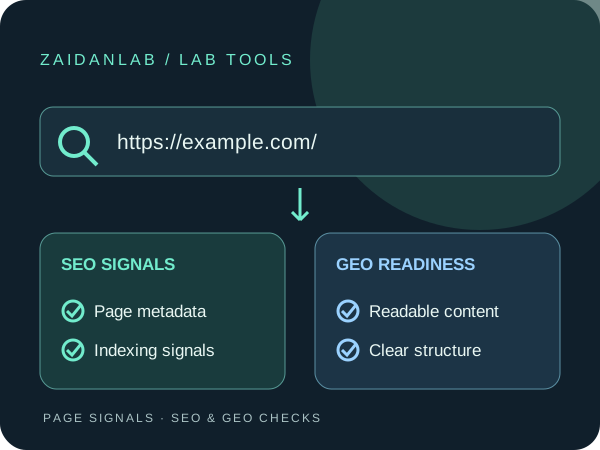
Website owners often get a single opaque score without knowing what was examined. This ZaidanLab tool offers an inspectable first step: enter a public page URL, see the technical content signals available in its initial HTML and decide which findings are worth investigating. It is not a client engagement or evidence of a measured ranking improvement. The cover diagram explains the workflow; run the tool to see findings for your own URL.
Try a Public Page
Launch the GEO & SEO page audit →
Enter a public homepage, article or product-page URL and select Run page audit. You will see two scores out of 100, each component's points, the observed signal and a suggested next step. The sample button checks the ZaidanLab homepage. No login, API key or AI model is used.
What SEO and GEO Scores Mean Here
SEO checks the HTML title, description, H1, canonical, noindex header/meta, image alt attributes, viewport and parsable JSON-LD. GEO is a separate, explicitly ZaidanLab-defined heuristic for noindex status, descriptive headings, readable server-delivered text, section headings, JSON-LD and page identity. The overlap is intentional and the weight of every check is visible. Extra informational signals include HTML language, Open Graph fields, internal and hreflang link counts, and declared JSON-LD types. Structured data is assessed for parsable JSON only, not schema correctness, search eligibility or factual accuracy. Short pages may not need two H2 headings. There is no agreed universal GEO scoring standard.
Bounded Public-URL Retrieval
A Cloudflare Pages Function fetches one publicly resolvable HTTP(S) hostname on standard ports. It checks public DNS addresses, revalidates up to three redirects and limits response time and HTML size. It also samples robots.txt, the root or first same-origin declared sitemap, and optional llms.txt at the final page origin. Bounded site-file requests do not follow cross-origin redirects. It rejects IP literals, private DNS resolutions and non-HTML/error page responses rather than giving a misleading score. User-entered URLs are sent to the ZaidanLab endpoint and the destination site; do not put credentials or sensitive tokens in a URL. This public audit tool is not a security-certified crawler.
The Important Blind Spots
Scores use only the initial HTML of the requested page plus its X-Robots-Tag header. Separate site-file observations report common Googlebot/GPTBot/ClaudeBot/PerplexityBot robots path rules, one sitemap's initial XML root and whether a root llms.txt resembles Markdown. Missing llms.txt does not lower either score: it is an optional convention, not a verified ranking signal or guarantee of AI citation. This tool does not render JavaScript, crawl the rest of the site, validate all sitemap URLs, test live bot access, measure Core Web Vitals, read Search Console, prove Google indexing or observe AI answers. A high score cannot establish search ranking, usefulness, factual quality or whether an AI product recommends the site. Conversely, a failed structural check may not suit every page type. Users should confirm findings before editing a live website.
 Chat via WhatsApp