The Moment Behind the Hype
Game reverse engineering did not begin with AI. What changed in October 2026 is the pace of visible projects and the argument over what counts as meaningful progress. A widely discussed October 14 post celebrated AI-assisted ports of older games. On October 15, 404 Media reported that decomp.dev was sunsetting. Its actual announcement is more specific than the shutdown headline: existing project pages and historical tracking continue, but the main index and new project additions are disabled. The maintainer credits AI with accelerating work, while blaming hostile forks, rushed ports and leaderboard chasing for damaging collaboration.
Decomp, Recomp and Port Are Different Things
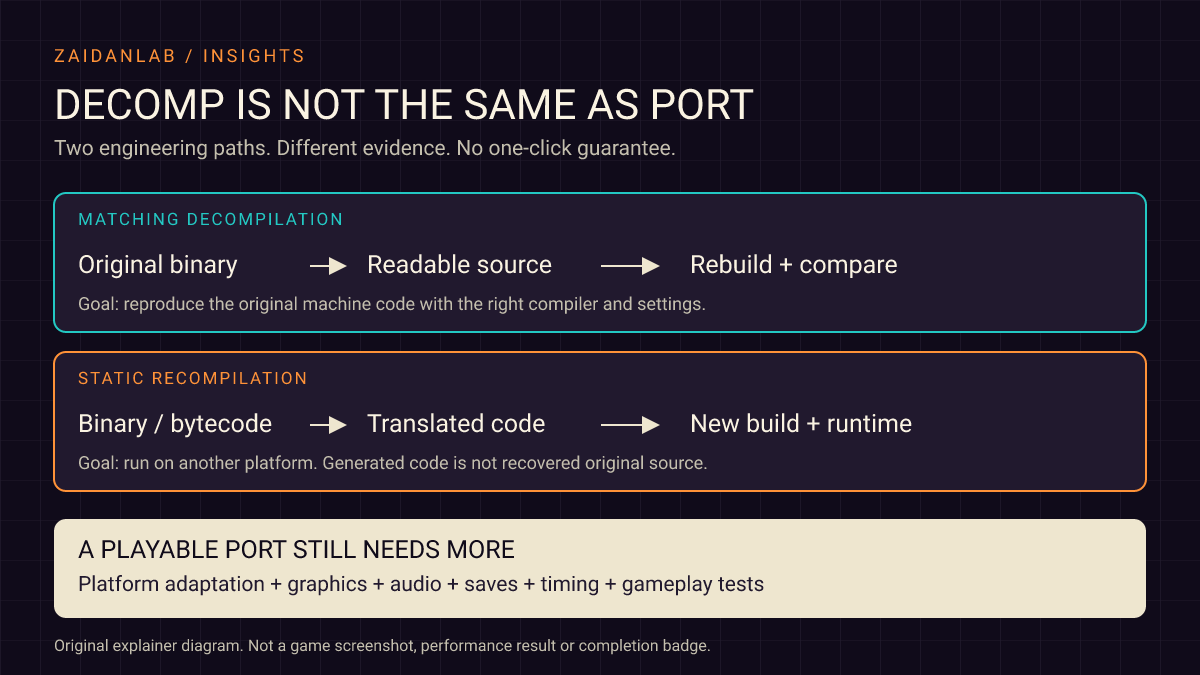
A decompilation reconstructs higher-level source from a compiled program. A matching decompilation aims to rebuild the original machine code with the appropriate compiler and settings; it does not recover the developers' exact comments or variable names. Static recompilation translates a binary or bytecode ahead of time into code that can run on another platform, often using generated C or C++ and a supporting runtime. A port is the outcome: a game adapted to another platform. It can be built from official source, a decompilation or a recompilation. The Ocarina of Time decompilation explicitly says it is not producing a PC port. Calling every native release a completed decomp hides both the method and the work still required.
Why AI Fits the Matching Loop
Matching gives an agent something stronger than a convincing-looking answer: compiler output to compare with a reference. The loop is concrete: propose source, compile it, inspect the instruction differences, revise and repeat. The decomp.dev maintainer describes newer agents as effective at trying source variations and cross-referencing symbols or debug information, with human guidance and code review still important. CMR2Decomp documents this in practice: it is heavily AI-assisted, rebuilds Colin McRae Rally 2.0 with Visual C++ 6.0, compares functions against the original executable and runs differential tests. Its authors also warn that reconstructed names, types and comments may be wrong. That is evidence of a useful workflow, not proof that any game can now be recovered in a weekend.
IsaacRecomp Shows the Preservation Opportunity
IsaacRecomp targets the original 2011 Flash version of The Binding of Isaac, not Rebirth. Its README discloses AI assistance and describes a static translation of ActionScript 2's AVM1 bytecode into C++, backed by a new native engine. The documented design keeps game logic at 30 ticks per second while interpolating rendering for higher-refresh displays. Graphics, sounds and music are loaded from the user's own Steam copy. This is a compelling preservation use case: replacing an ageing runtime while retaining access to a purchased game. It is also a good terminology check. A project called a recomp, translating Flash bytecode, is not automatically evidence of a fully matching native-machine-code decompilation.
Automation Is Not Automatically AI
The N64Recomp tool mechanically translates N64 instructions into C functions and expects a runtime to supply the surrounding platform functionality. That process is not, by itself, generative AI. Zelda 64: Recompiled uses static recompilation for its Majora's Mask port and explicitly bans generative-AI contributions. Its FAQ explains that a port can bypass the need for fully decompiled source, while still benefiting from the decompilation team's reverse-engineering knowledge. Do not retroactively label established community tools or ports as AI achievements just because they automate difficult work. The current wave depends on years of compilers, comparison tools, runtimes and community research.
Why 100% Does Not Mean Finished
Before trusting a completion badge, ask what it measures: functions with reconstructed source, exactly matching code bytes, approximate instruction similarity, or the whole rebuilt binary. CMR2Decomp distinguishes exact byte matching from fuzzy similarity; having source for every identified game function does not mean every function matches. Even a genuine complete match targets a particular original build. It does not prove a modified port has correct graphics, audio, saves, controls or timing on a different platform. Nor does it establish that the source is understandable enough to maintain. A title screen proves the game boots. It does not prove the final level, a rare item interaction or save recovery works.
Look for Tests Beyond the Trailer
OpenCMR2, the separate native port built on CMR2Decomp, illustrates the next layer of evidence. Its documentation reports comparisons of 500 vehicle updates on a recorded Finland-stage input sequence against the original game with SilentPatch, at several fixed frame rates and a variable rate. That is a scoped physics-parity check—not proof of every race, platform or network condition. The README separately identifies platforms where builds and tests pass but gameplay has not yet been tested. For any port, look for this separation between implemented, compiled, tested and played. Reproducible checks and honest known-issue lists tell you more than an impressive clip.
The Community Objection Is Not Just Fear of Faster Tools
The decomp.dev announcement does not say AI is inherently forbidden. It says low-effort contributions, forks that race to finish other people's work and premature ports undermine the community it was designed to support. In an October 16 response, a LEGO Island decompilation contributor describes understanding the original engineering and enjoying the reconstruction process as goals in their own right. Players wanting an accessible port and researchers wanting a readable historical reconstruction are pursuing different outcomes. Both are legitimate. The constructive response is to respect each project's contribution and AI policies, preserve attribution, follow applicable licences and offer work upstream rather than treating its progress chart as a shopping list.
Preservation Does Not Remove Copyright or Security Questions
The projects discussed here require users to supply their own game data; a repository is not a free copy of the game. Do not assume that owning a disc, excluding assets or generating code with AI provides blanket permission to copy or distribute everything else. Copyright, licence terms and restrictions on bypassing access controls are separate questions that depend on the jurisdiction and facts. The U.S. Copyright Office's Section 1201 materials, for example, describe a specific exemption process—not universal permission for game preservation. This is not legal advice. There is a practical security boundary too: use the project's original repository, review releases and permissions, and back up saves before testing an unofficial executable.
The Real Breakthrough Is a Better Feedback Loop
The strongest lesson is not that an AI can magically recover every game, or that a matching percentage replaces expertise. It is that agents can make progress on tightly specified tasks when tools provide objective feedback. For preservation, the valuable result is reproducible source and builds, documented behaviour, credited dependencies and a port somebody can keep maintaining. More native ports can be a real win without erasing the people who made them possible. For the broader tooling trend, see our analysis of AI reverse-engineering tools. Source review: October 19, 2026. Project capabilities and test results above are attributed to their documentation; ZaidanLab has not independently built or play-tested these games.
 Chat via WhatsApp