PHP2Shell: the vulnerability sits in the runtime
On October 21, 2026, the PHP project released fixes for two critical vulnerabilities collectively known as PHP2Shell: CVE-2026-109618 and CVE-2026-109619. Both can allow unauthenticated remote code execution. PHP's official announcement identifies installations serving web requests as at risk, including PHP-FPM, Apache mod_php, php-cgi, FrankenPHP, and LiteSpeed. PHP considers the risk highest for mod_php, with a demonstrated exploit that triggers before application code runs.
The CVE-2026-109618 advisory describes out-of-memory handling that can leave internal request state invalid. With CVE-2026-109619, global state can still reference memory belonging to a completed request and be consumed by a later request. Because these flaws are in the engine executing PHP, updating a CMS or plugin alone may leave the vulnerable component untouched.
Exposure does not establish that every PHP website has been compromised. Whether an exploit chain succeeds depends on the version, configuration, runtime setup, and application behavior. PHP's share of websites is not a victim count. Assess each installation against the advisories and the vendor packages it actually runs.
What does this have to do with advances in AI?
In its October 21, 2026 research report, Wiz says AI assisted vulnerability discovery, exploit development and adaptation, attack detection, and patch validation. The team describes models helping analyze failures and repeat tests against different memory layouts. These benefits are reported by the researchers who performed the work; this article does not independently measure their speed gains.
Calif's account adds important context: the initial discovery was guided by a researcher who understood PHP's vulnerability history and had a hypothesis about where to look. Calif says the initial discovery did not require special models unavailable to the public. AI helped with difficult technical work, while target knowledge, research direction, and validation remained important.
The implication is that technical complexity may become a weaker practical barrier to exploitation. If analysis, debugging, and adaptation can be repeated at lower cost, more variations of a target can be investigated. That is our inference from the research, rather than evidence that every PHP2Shell attack used AI or that AI can automatically compromise any system.
The timeline: attackers do not wait for public disclosure
Amazon Threat Intelligence reports an exploitation attempt in its MadPot sensors on October 17, 2026, four days before public disclosure. On October 21, it observed PoCs and additional attempts before the official embargo ended at 14:00 UTC. AWS explicitly says analysis was ongoing and that it was unclear whether those attempts would have succeeded against real-world systems.
The patch date is therefore an unsafe starting assumption for an investigation. For PHP2Shell, AWS recommends looking back to at least October 17. That is the earliest observation it reports, not a guarantee that no earlier activity occurred elsewhere. Available logs, retention periods, and evidence on each system still determine the investigation's scope.
The distinction between attempts and confirmed compromise also matters when reading Wiz's October 27 update. Its researchers observed attempts, but the exploit chains captured in their observations did not complete. They also found PHP2Shell-branded tools that actually relied on session poisoning and a separate local file inclusion vulnerability. Results from one telemetry dataset cannot establish that attacks failed everywhere on the Internet.
Why can the risk increase as AI becomes more capable?
Three pressures deserve attention: more code can be examined, adapting techniques to different targets can become cheaper, and more repetitive work can be automated. The business risk grows when the capacity to attempt attacks increases faster than an organization's ability to identify affected assets and update them. Systems already falling behind on maintenance are particularly exposed to that gap.
The NCSC's May 2025 assessment anticipated AI strengthening intrusion operations and shortening the time between disclosure and exploitation. Its November 3, 2026 follow-up examines threats through 2028 using several scenarios. NCSC explicitly describes these as plausible possibilities, not certain predictions. Both reports focus on the UK; their relevance to businesses elsewhere lies in the mechanisms they describe, rather than local incident rates.
It would nevertheless be too simplistic to say that AI inevitably makes every system less secure. AI also helps defenders investigate vulnerabilities and validate fixes. The operational question is whether asset inventories, testing, approval processes, and incident handling can keep pace with changing capabilities.
Updating PHP: check the runtime actually serving traffic
The two PHP advisories list the initial fixed releases below. These versions address the two named CVEs; they are not a claim about the latest available releases or freedom from other vulnerabilities. Choose a supported release containing current security updates. For distribution packages carrying backported fixes, check the vendor advisory instead of relying only on the upstream version number.
| PHP branch | Initial fixed release |
|---|---|
| 8.2 | 8.2.35 |
| 8.3 | 8.3.36 |
| 8.4 | 8.4.27 |
| 8.5 | 8.5.12 |
Do not stop at checking PHP in a terminal. A website may use a different PHP-FPM pool, Apache module, container image, or hosting runtime. Verify that the processes serving requests use the fixed package and that old workers have been restarted or replaced through the deployment procedure. Check queue workers and other long-running PHP processes too. Retain evidence of the active version and the application checks performed after the change.
A subsequent PHP advisory on October 23 also described CVE-2026-115560 under an unusual combination of configuration and application code. That is separate from the two main PHP2Shell CVEs. It is another reason to keep following vendor updates after an emergency patch instead of assuming one version number settles every later risk.
A WAF adds protection; it does not complete remediation
Cloudflare reports deploying WAF protections before public disclosure, combining request and response signals to help identify exploitation attempts. Cloudflare still tells customers to update PHP. A rule's coverage depends on the patterns and traffic paths it protects. Having a WAF, or a record of blocked requests, does not prove that the runtime has been patched or that no earlier compromise occurred.
Configuration changes also have limits. PHP states that only an update completely addresses both issues. Avoid copying changes such as removing memory limits without understanding their availability implications. If patching is delayed, choose temporary mitigations with the system operator, test application behavior, record the remaining exposure, and set a remediation deadline.
Practical steps for website owners and development teams
The following operational recommendations synthesize the advisories and reports above. Prioritize vulnerable Internet-facing systems with access to important data or services, and assess their urgency before the next routine maintenance window.
- Map assets and ownership. Inventory websites, administration panels, APIs, containers, runtimes, and hosting providers. Obtain written confirmation when a vendor manages updates.
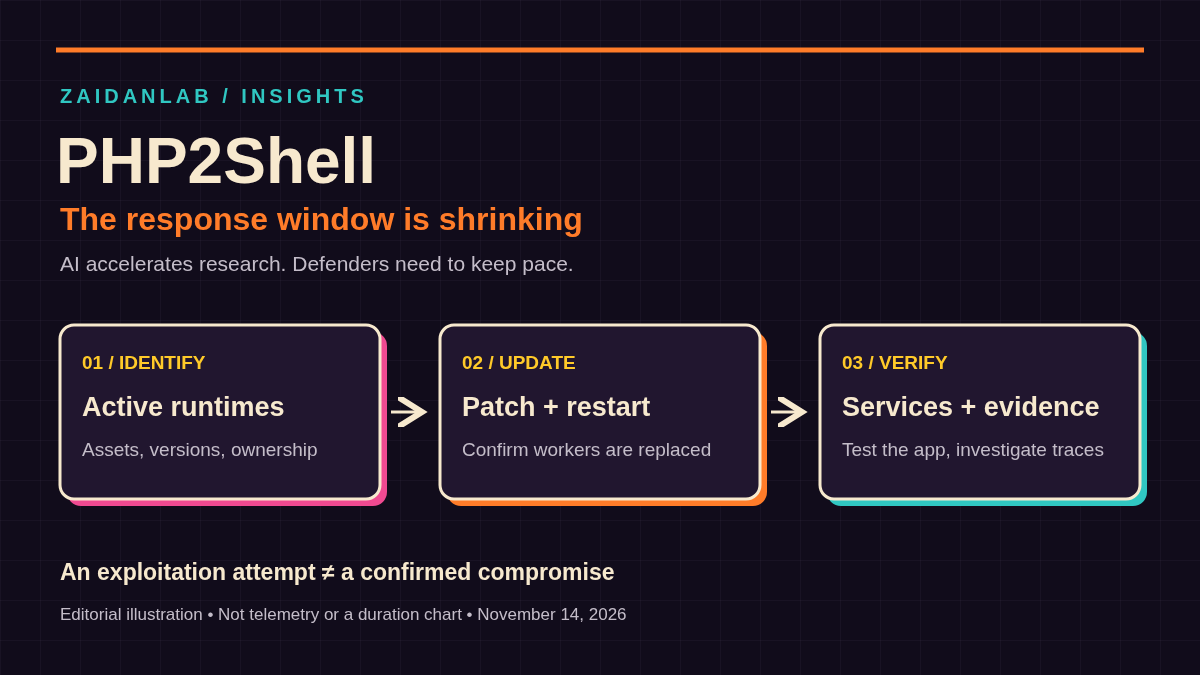
- Update and verify active processes. Test important workflows, replace or restart workers through the appropriate procedure, and recheck the services receiving traffic.
- Investigate possible compromise separately. Correlate web logs, unusual processes, file changes, and account activity. Errors or worker restarts are investigation leads, not standalone proof of successful exploitation.
- Activate incident response when evidence warrants it. Preserve evidence, contain affected systems, and determine recovery and credential rotation from the scope of attacker access. A patch does not remove access an attacker has already established.
- Rehearse before the next incident. Verify that backups can be restored, logs are retained long enough, and the team knows who can authorize emergency updates.
Connecting AI agents adds another access boundary
Additional risks arise when AI is connected to email, repositories, databases, or administration tools. OWASP's prompt injection guidance describes how content a model reads can influence its behavior in unintended ways. Its Excessive Agency guidance emphasizes limiting functionality, permissions, and autonomy. This is a separate risk category, rather than the cause of PHP2Shell.
For business integrations, start with read-only access where sufficient, separate credentials, minimum permissions, and human approval for sensitive changes. Authorization checks must remain in the system executing the action. Prompt instructions cannot replace access controls. These boundaries help prevent an attempt to accelerate work with AI from also giving one component the ability to change an entire system.
The lesson: shorten the path from evidence to response
PHP2Shell shows how AI-assisted research can turn a difficult vulnerability into a problem requiring real patches and coordinated action. For businesses, the useful next step is to know what is running, who updates it, how to verify the result, and what happens if evidence points to compromise. Security operations need to keep pace with the tools available to both attackers and defenders.
Sources reviewed on November 14, 2026. This article draws on official advisories, researcher reports, security-provider observations, and government assessments. ZaidanLab has not run exploits against third-party systems or independently audited the providers' telemetry. For related context, read our analysis of AI reverse-engineering tools.