How We Measured It
We queried Google Trends for the 30 days from 4 October to 4 November 2026, separately for each of the seven countries. We compared Google's topics rather than raw keywords, so “Java” means the programming language and not coffee, and “Angular” means the web framework and not the medical term. Google Trends compares at most five items at a time, so we used six groups of five: languages, more languages, frontend, backend, infrastructure and mobile.
The numbers below are the average daily interest on Google's 0–100 scale, where 100 is the busiest day for any item in that group and country. Two limits matter. First, a value only compares items inside one group in one country: React at 76 in the US and 68 in Indonesia does not mean Americans search for React more. Second, a search shows that people are learning, comparing or fixing something. It is not a count of production deployments or job openings.
Languages: Python First, Java Second, Everywhere
In every country Python had the highest search interest of the languages we compared, and Java was second. We used the daily median for this group, because PHP jumped to the top of the scale in all seven countries on 21–23 October 2026 and would otherwise inflate its average.
| Country | Python | Java | JavaScript | PHP | TypeScript |
|---|---|---|---|---|---|
| United States | 31 | 20 | 10 | 2 | 1 |
| Indonesia | 30 | 18 | 16 | 13 | 1 |
| Australia | 15 | 10 | 6 | 2 | 1 |
| Germany | 7 | 5 | 3 | 2 | 0 |
| Sweden | 12 | 7 | 5 | 2 | 0 |
| France | 15 | 6 | 5 | 3 | 1 |
| Italy | 20 | 13 | 7 | 6 | 0 |
Indonesia stands out: PHP's normal level there (13) is several times higher than in any other country. In a second group we compared Python with Go, Rust, C# and Kotlin. Against Python at roughly 70–80, Go was strongest in the US (16.5), Italy (12.3) and France (10.5). C# was strongest in Sweden (16.7), Germany (13.7) and Australia (12.2). Rust stayed between about 6 and 10 in every country, highest in Germany (9.7), and Kotlin stayed low at 1–2.5.
Low TypeScript search interest does not mean low use. GitHub's Octoverse 2026 ranks TypeScript first by contributors, ahead of Python and JavaScript. Developers usually search for the framework they are working in, not for the language underneath it.
Frontend: React Leads, Angular Is Europe's Second Choice
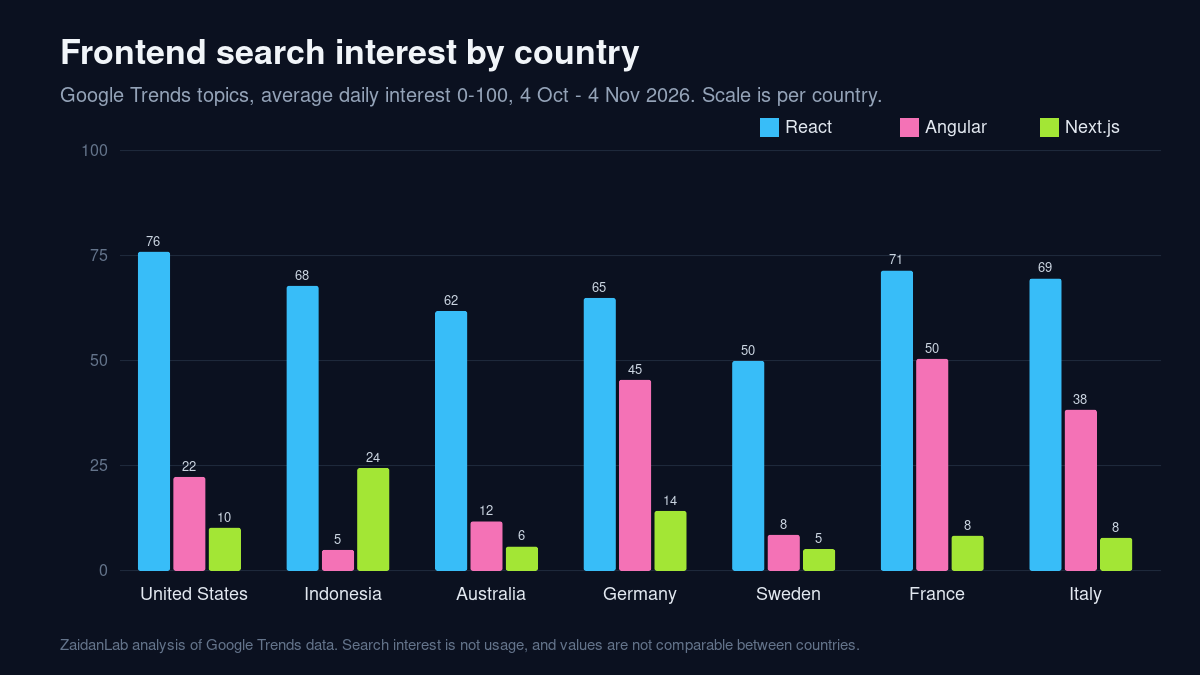
React was the most searched frontend framework in all seven countries. The country differences show up in second place.
| Country | React | Angular | Next.js | Vue.js | Svelte |
|---|---|---|---|---|---|
| United States | 76 | 22 | 10 | 4 | 4 |
| Indonesia | 68 | 5 | 24 | 8 | 2 |
| Australia | 62 | 12 | 6 | 2 | 2 |
| Germany | 65 | 45 | 14 | 10 | 3 |
| Sweden | 50 | 8 | 5 | 3 | 1 |
| France | 71 | 50 | 8 | 11 | 3 |
| Italy | 69 | 38 | 8 | 5 | 1 |
Angular stays close to React in France, Germany and Italy, much more than in the US, Australia or Sweden. Indonesia is the only country where Next.js is clearly second, at 24 against Angular's 5. Vue.js is highest in France and Germany, although it is still small next to React.
Backend: Node.js Almost Everywhere, Laravel in Indonesia
| Country | Node.js | Laravel | Spring | Django | ASP.NET |
|---|---|---|---|---|---|
| United States | 56 | 6 | 14 | 7 | 6 |
| Indonesia | 38 | 42 | 2 | 2 | 1 |
| Australia | 54 | 6 | 3 | 4 | 3 |
| Germany | 44 | 8 | 11 | 5 | 2 |
| Sweden | 36 | 3 | 4 | 1 | 3 |
| France | 35 | 5 | 6 | 3 | 1 |
| Italy | 46 | 11 | 9 | 2 | 3 |
Node.js led in six of the seven countries. Indonesia is the exception: Laravel (42) edged past Node.js (38), which matches the country's high PHP interest. The Spring framework for Java was the clear second in the US and Germany, while Italy split its second place between Laravel and Spring.
Infrastructure and Mobile
Docker was the most searched infrastructure topic in every country, between 55 and 73. The US had the highest relative interest in Kubernetes (31) and PostgreSQL (34). Indonesia leaned towards hosted backend services: Supabase (42.5) was level with PostgreSQL (41), and Firebase reached 30, far above its 2–10 in the other countries. In Italy, Supabase (21) was already ahead of Kubernetes (18).
For cross-platform mobile, Flutter interest was high in Italy (40), Indonesia (36), Germany (26) and France (23), each measured against React in the same group, but low in Sweden and Australia (5–9).
Country Snapshots
- United States: Python, React and Node.js, with the strongest relative interest in Go, Spring and Kubernetes.
- Indonesia: the most distinct profile. Laravel ahead of Node.js, PHP still strong, Next.js second in frontend, and high interest in Supabase, Firebase and Flutter.
- Australia: a simpler version of the US pattern, with React, Node.js, Python and C#.
- Germany: React and Angular close together, with relatively high Spring, C#, Rust, Flutter and Kotlin, a profile typical of larger enterprises.
- Sweden: the strongest C# interest of the seven, plus React and Node.js, and almost no Flutter.
- France: the highest Angular score (50) and the highest Vue.js, plus solid Go.
- Italy: React and Angular, the highest Flutter score, and noticeable Laravel, Spring and Supabase.
How This Fits With Usage Surveys
Search interest and usage surveys agree on the big picture. In the Stack Overflow Developer Survey 2026, JavaScript (62.0%), SQL (58.4%), HTML/CSS (58.2%) and Python (58.0%) are the most used languages, followed by Bash/Shell (51.3%), TypeScript (43.8%), Java (27.6%) and C# (27.1%). PostgreSQL leads the databases at 57.9%, ahead of SQLite (42.1%) and MySQL (35.1%). The survey is global, though, so it cannot show the country differences that Google Trends does.
If you are choosing a stack for a product, hiring in one of these markets, or deciding what to learn next, use these country patterns as a starting point, then check live job listings in that market. A spike can come from a release, an outage or a tutorial going viral. Data pulled on 4–5 November 2026; Google Trends values are sampled and can change slightly when queried again.
 Chat via WhatsApp